


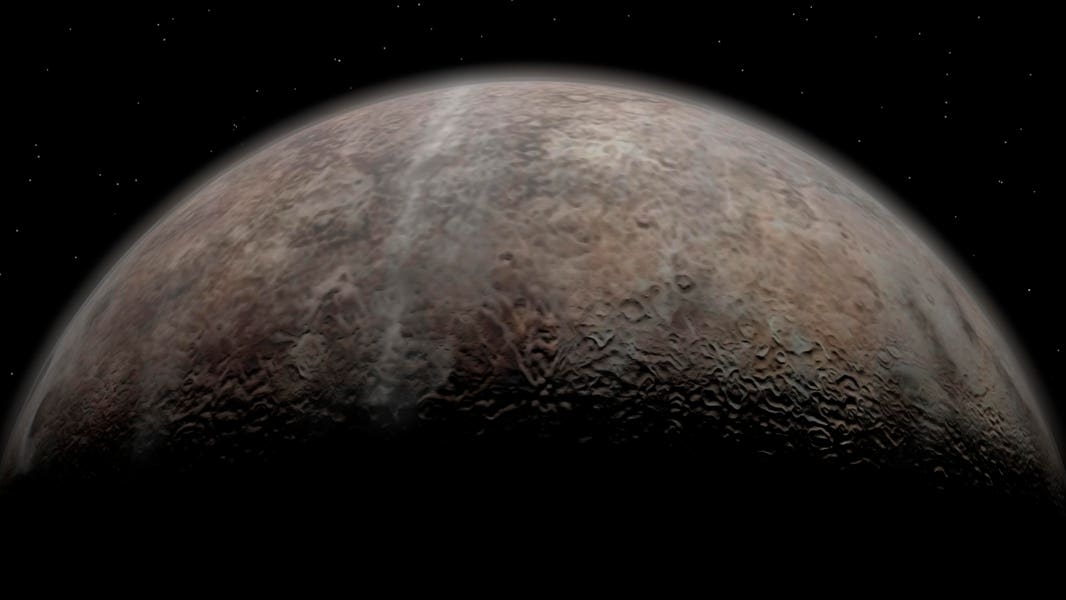
In an exciting discovery that could change our understanding of the solar system, astronomers have identified a new trans-Neptunian object known as 2023 KQ14, affectionately nicknamed “Ammonite.” This celestial body is not classified as a planet but rather as a “sednoid,” a term used for objects with highly eccentric orbits that lie beyond Neptune and Pluto. With its unique characteristics and location, Ammonite challenges existing theories about the formation of our solar system. This article will delve into the details surrounding Ammonite’s discovery, its significance in astronomical studies, and what it reveals about the mysterious outer reaches of our cosmic neighborhood.
Understanding Ammonite: A New Addition to Our Solar System
Discovered through advanced imaging techniques at Mauna Kea in Hawaii, Ammonite is a faint object located approximately 71 astronomical units (AU)—the average distance from the Earth to the Sun—away from our star. For context, one AU equals about 93 million miles (150 million kilometers). The object’s size is estimated to range between 137 to 236 miles (220 to 380 kilometers) in diameter. Despite its relatively modest size compared to other celestial bodies like dwarf planets, Ammonite’s eccentric orbit sets it apart.
The Journey of Discovery
The detection of Ammonite was no easy feat. Unlike brighter exoplanets that are often visible when they transit their stars, this sednoid reflects very little sunlight and appears dim even through powerful telescopes. Astronomers initially spotted it using the Subaru Telescope’s Hyper Suprime-Cam before confirming its orbit with data from the Canada–France–Hawaii Telescope’s MegaCam.
This advanced technology allowed scientists to capture long-exposure images where Ammonite appeared as a faint dot amidst countless stars. Such discoveries highlight not only advancements in telescope technology but also an increasing understanding of distant solar system objects.
Where Does Ammonite Fit In?
As a trans-Neptunian object (TNO), Ammonite occupies an intriguing region of space known for being sparsely populated with known celestial bodies. It lies beyond the Kuiper Belt—a zone filled with icy objects—and may transition into what we call the inner Oort Cloud, which is thought to house billions of comets and other remnants from the early solar system.
The significance of locating such objects extends beyond mere curiosity; it offers insights into how our solar system evolved over billions of years. With an orbital period potentially spanning up to 10,000 years around the Sun, studying these distant bodies allows astronomers to glean information about early planetary formation processes.
The Importance of Sednoids
A Glimpse Into Our Solar System’s History
Ammonite represents only the fourth known sednoid discovered so far. The primary archetype is Sedna itself—a dwarf planet larger than Ammonite—whose orbit takes it anywhere from 76 AU up to an extraordinary distance of approximately 937 AU from the Sun. Two additional sednoids were identified prior: 2012 VP113 (nicknamed “Biden”) and 541132 Leleākūhonua.
The existence of these sednoids raises questions about their origins and how they came to occupy such detached orbits far from other planets in our solar system. The presence of numerous small bodies exhibiting strange trajectories suggests influences beyond those exerted by well-known planets like Jupiter or Saturn.
The Planet Nine Hypothesis
A fascinating aspect surrounding these distant objects involves theories regarding Planet Nine—an elusive massive body hypothesized to exist far beyond Pluto’s orbit based on gravitational anomalies observed among TNOs like sednoids. While some scientists believe that this unseen planet may influence their unusual orbits, findings related to Ammonite could challenge this theory.
Ammonite’s trajectory does not align neatly with those predicted by gravitational interactions involving Planet Nine; hence its discovery opens new avenues for explanations regarding these enigmatic celestial bodies:
- A ninth planet exists but remains incredibly distanced from us.
- A hypothetical ninth planet once existed but was ejected from our solar system long ago due to gravitational forces.
- A star may have passed close enough in history that it impacted what’s now considered detached orbits within this region.
The Broader Implications
This groundbreaking discovery serves as a reminder that there is much more left unexplored within our solar system than previously thought. As we learn more about objects like Ammonite and other TNOs on similar orbits, we gain perspective on how chaotic forces have shaped our cosmic neighborhood over eons.
The ongoing search for additional sednoids underscores humanity’s quest for knowledge—the more we observe these distant realms through improved technology and methodologies, the clearer picture we can paint regarding origins and evolutions in cosmic history.
Conclusion: Beyond Pluto Lies More Than Meets The Eye
The unveiling of ‘Ammonite’ enriches our understanding not just about distant trans-Neptunian objects but also highlights gaps within current models explaining orbital behaviors across vast distances—signifying there’s still much left unknown surrounding planetary formation processes.
As research continues into this newfound world among others yet undiscovered—the potential discoveries awaiting us out there inspire awe while challenging established norms concerning where exactly our knowledge ends; reminding us every time we gaze upwards at night—that exploration holds infinite possibilities!